
~/research
Machine learning for touch, when data is scarce and every user is different
Electrovibration touchscreens create tactile feedback by modulating friction with voltage. The friction a finger actually feels depends on skin moisture, contact area and how each person touches. Data is expensive to collect: every sample needs a participant, special hardware and a controlled experiment. My research asks how to build models that learn from very little data and still generalise to users they have never seen, by combining data-driven learning with the physics of contact.
- Group
- Cognitive Robotics, Mechanical Engineering, TU Delft
- Supervision
- Dr. Yasemin Vardar (supervisor) · Celal Umut Kenanoglu (daily supervisor)
MSc thesis · Sep 2026 – Mar 2027 (in progress)
Data-efficient, variability-robust ML for dynamic electrovibration rendering
State-of-the-art models ground electrovibration in contact mechanics and adapt to each user through fitted scaling factors. In practice, that requires profiling every user across many force–speed conditions. My thesis replaces this with a short calibration: a network learns a latent representation of the user from a few calibration touches, and an inverse model uses it to predict the actuation voltage that produces a target electrostatic force.
input
Sparse user calibration
a few baseline touches
encoder
Latent user representation
captures skin & touch behaviour
inverse model
Voltage prediction
given Fn, v and the target Fe
To keep predictions physically plausible and to reduce the data needed, the network is trained with a composite, physics-informed loss:
Ltotal = λdata Ldata + λelec Lelectrostatic + λfric Lfriction
- Data term: MSE between predicted and measured voltage.
- Electrostatic term: anchors the predicted Fe to a parallel-plate capacitor model with learned effective capacitance and apparent contact area.
- Friction term: enforces the Bowden–Tabor relation between tangential force, real contact area and interfacial shear stress.
The thesis asks three questions:
- How well can data-driven and physics-informed models map sparse calibration data to electrostatic force?
- How accurately can an inverse model use that representation to estimate the required voltage?
- How much does the pipeline improve data efficiency and accuracy over multi-condition regression baselines?
Research assignment · Jan – Jun 2026 (completed)
Machine learning for electrovibration under small data and user variability
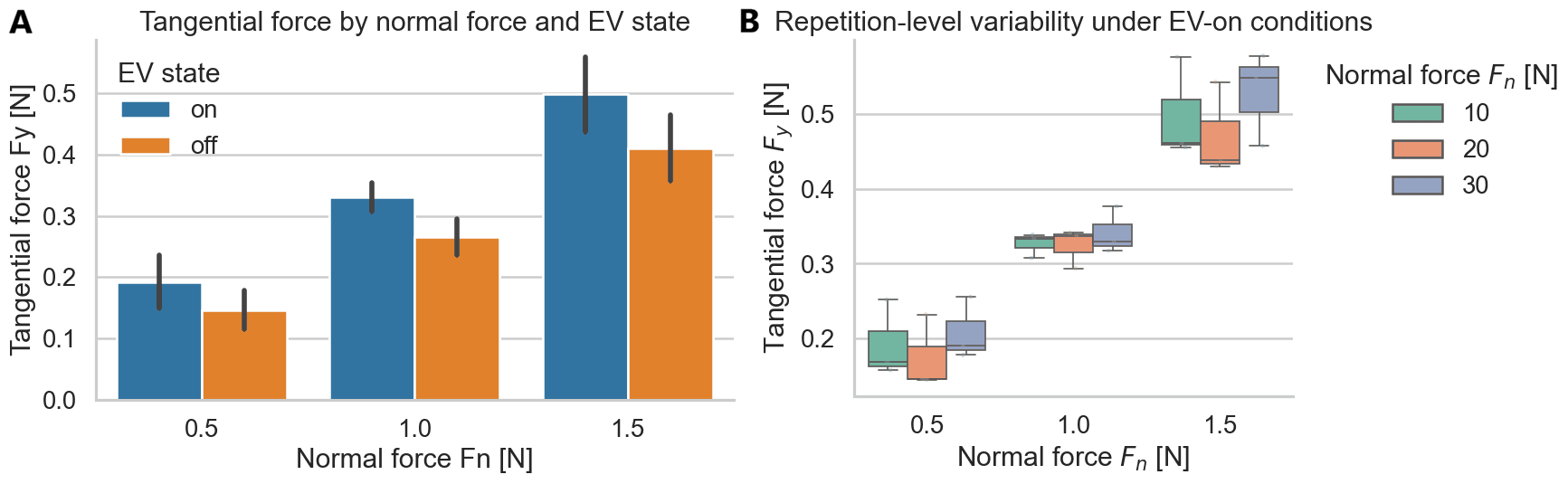
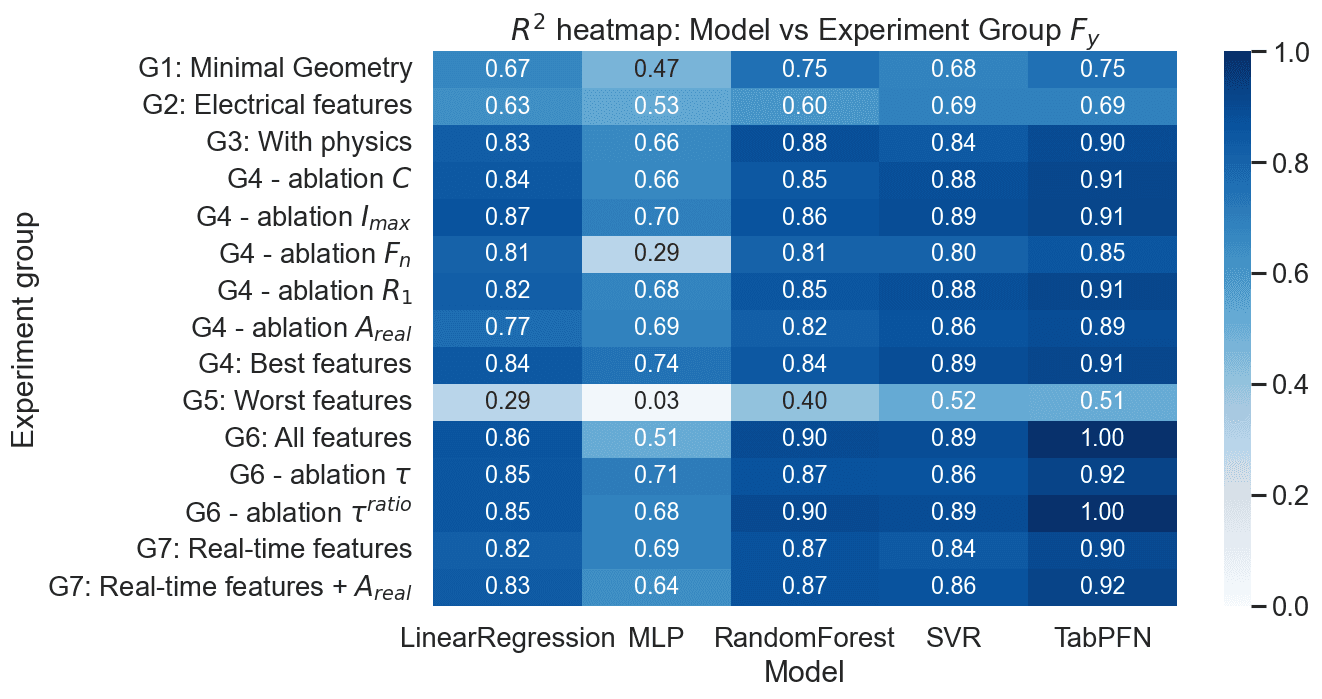
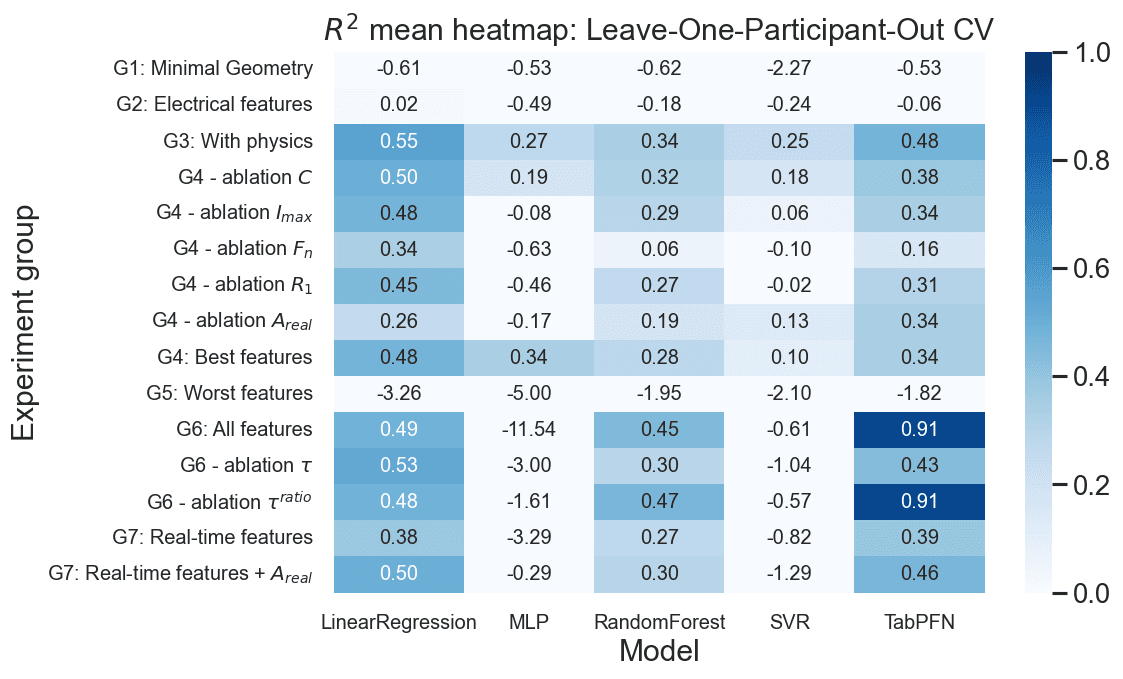
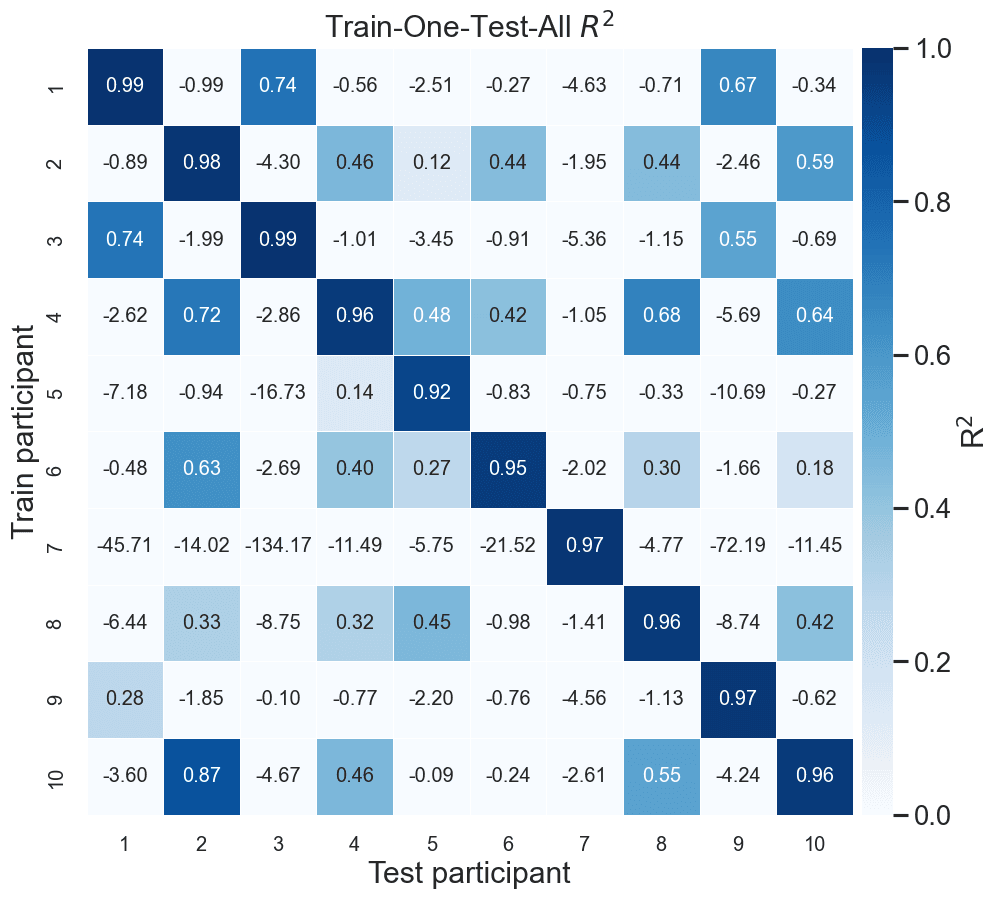
Can machine learning predict the friction (tangential) force on an electrovibration display across people, from a small dataset? I analysed measurements from 10 participants × 3 trials, covering normal forces of 0.5–1.5 N, sliding speeds of 10–30 mm/s and 100 V / 75 Hz actuation. Features came from contact geometry (apparent and real contact area), an equivalent-circuit model of skin impedance, and statistics of the actuation current. I compared linear regression, random forest, SVR, MLP, Gaussian process regression and TabPFN on 15 feature groups and ablations, using three protocols: random 80/20 splits, leave-one-participant-out validation, and train-on-one/test-on-all transfer.
- TabPFN on a random split, with the best leakage-free feature set
- R² 0.91
- best mean score on unseen participants (leave-one-out, linear model)
- R² 0.55
- friction increase from electrovibration across all normal forces
- +20–30%
Findings
- Contact area and current carry the signal. Real contact area, peak current and current variability correlate most strongly with friction (Spearman ρ ≈ 0.81–0.82); sliding speed barely matters (ρ ≈ −0.07).
- Within the same participants, prediction works. TabPFN, random forest and SVR reach R² 0.84–0.91. A feature set that can be measured in real time gets close, at R² 0.90.
- New users are the hard part. On held-out participants, performance drops to about R² 0.5 and varies widely per person, from 0.84 to below zero for one outlier participant. Excluding that participant raises the random-forest mean from 0.44 to 0.58 and halves the spread.
- Users form clusters. Models trained on one participant transfer well to some others (for example P1 ↔ P3 ↔ P9) and fail on the rest. This suggests user profiles could replace a single universal model, which is the idea behind the thesis.
- Beware physically “helpful” features. Adding interfacial shear stress τ gave a perfect R² = 1.00, but only because Fy = τ·Areal leaks the target. I report the leakage-free numbers instead.
- Accuracy vs. latency. TabPFN is the most accurate but needs about 0.3 s per prediction. Classical models are near-instant, which is a real trade-off for closed-loop control.
Literature review · completed Sep 2026
Data-efficient and variability-robust machine learning in haptics
A targeted Scopus review of machine learning for haptic systems under two bottlenecks: physical variability and data scarcity. It is organised around five sub-questions (physics-informed modelling, data generation, user variability, data efficiency and tactile AI foundations).
- 868 unique articles
- 204 after title screening
- ~50 core studies
Robustness to variability
User, interaction and sensor variability, and how models degrade under each kind of domain shift.
Data-efficient learning
Representation learning, transfer learning, and few-shot and meta-learning for tactile data.
Physics & synthetic data
Physics-informed networks that constrain predictions, and generative models that expand training sets.
The gap it identifies: adapting to individual users dynamically, without extensive calibration. Most frameworks assume standardised interactions or rely on costly post-hoc personalisation. The review argues for modelling human variability as a physical parameter rather than as noise.
SUSTech · 2019 – 2021
Earlier research: wearable load-carrying robots
“Centaur” load-carrying walking robot
BEng thesis · 2020 – 2021
A supernumerary-leg robot that walks with its wearer. I developed IMU-based gait perception that combines a linear inverted pendulum model with zero-velocity-update foot tracking, compared it with phase-variable gait detection, and designed gait generation and position control. These were verified in Simulink and on the hardware platform.
Elastic backpack with electrostatic damping
Research project · 2019 – 2020
An elastically suspended back frame that reduces the load on the carrier. I designed and prototyped the electrostatic damping mechanism and ran motion-capture experiments, which led to a conference paper and a patent.
Publications & patents
- conferenceY. Leng, X. Lin, R. Deng, et al. “Design and Implement an Elastically Suspended Back Frame for Reducing the Burden of Carrier.” IEEE International Conference on Advanced Robotics and Mechatronics (ICARM), 2021.
- patentChinese invention patent on the elastically suspended back frame (co-inventor), CN201911056953.9, filed 2019.
looking for a PhD from 2027
What I want to work on next
Haptics is where I apply these methods today. The thread through all my work is learning about humans from small, noisy data, using physics as a prior. For a PhD I'm most interested in:
- Physics-informed machine learning: combining physical models with learned components where data is scarce, in robotics, contact mechanics or other physical systems.
- Few-shot adaptation to individual users: models that personalise from a short calibration, in haptics, wearable robotics or human–robot interaction.
- AI for games and interactive systems: believable agent behaviour and player-adaptive experiences, with or without haptic interfaces. My Crusader Kings III AI mod is a small, real-world example.
If your group works on any of these, I would be glad to talk: ranbaodeng@outlook.com. The engineering side of my work is on the projects page.